
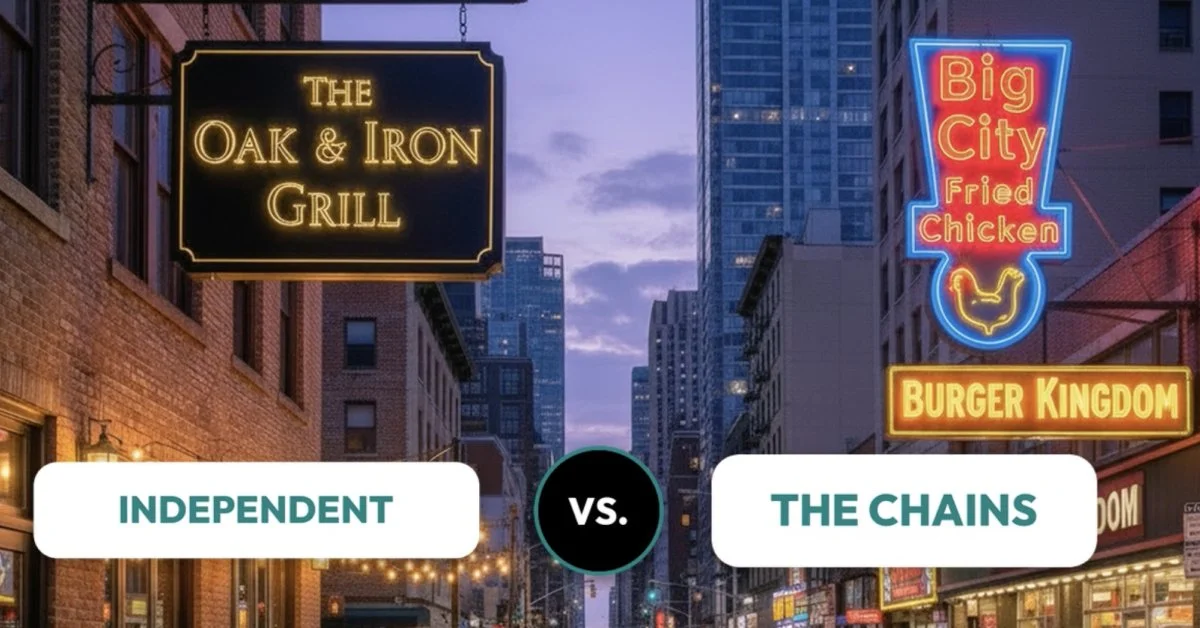
If you run an independent restaurant, you've probably looked at what the big chains are doing, the apps, the loyalty programs, the email marketing, the Google ad campaigns, and thought: how am I supposed to compete with that? The good news is that a few focused independent restaurant marketing tips, especially around online ordering for small restaurants, can close most of that gap fast. In several important areas, independent restaurants already have an advantage chains would genuinely pay to have.
Where chains actually have the advantage
Let's be honest about what chains have that independents don't: budget, engineering teams, dedicated marketing departments, and the benefit of name recognition across every market they operate in. A Chipotle or Wingstop can run national brand campaigns, negotiate software contracts at lower per-location costs, and test new features across thousands of locations.
For most independent restaurants, those things feel unreachable. And in those specific areas, they are. But those aren't the areas where local restaurant decisions get made.
Where independent restaurants have the edge
Local SEO actually favors independents. When someone searches "best tacos near me" or "pizza delivery in [your neighborhood]," they are looking for something local, and Google's algorithm knows it. A well-optimized independent restaurant can consistently outrank a chain in local search because Google rewards relevance, proximity, and local signals over brand size.
Non-branded searches
Per Think with Google research, most people aren't searching for Domino's, they're searching for "pizza near me." That's your territory.
Agility
An independent restaurant can change its menu tonight, launch a flash deal this afternoon, run a new campaign tomorrow morning. Chains operate on quarterly planning cycles.
Community
Your regulars aren't loyal to a brand managed from a corporate office in another city, they're loyal to you, your staff, your food. That's the most durable advantage in food service.
The technology gap is closing
The most significant shift in the past several years is the democratization of restaurant marketing technology. Tools that once required enterprise contracts, including online ordering systems, loyalty programs, automated email and SMS marketing, Google listing management, and AI-powered review replies, are now available to independent restaurants at accessible price points through done-for-you platforms.
Then
Enterprise contracts and marketing teams required
Now
Done-for-you platforms, priced for one location
If you haven't already, start with what you're paying today. Once you see the real math on restaurant delivery app fees, direct ordering stops looking optional, and every dollar you stop giving away in commission is a dollar you can put toward the tactics below.
You don't need to hire a marketing team. You need a platform that does the marketing for you.
The 30-day competitive reset
Starting from zero? Here's the priority order for closing the gap with chains quickly.
Claim and fully optimize your Google Business Profile
Free, highest impact. This is where most restaurant searches start.
Set up direct online ordering connected to Google Food Ordering
One click for guests, no third-party commission for you.
Activate automated post-order email and SMS follow-ups
Stay in touch with guests without lifting a finger after every order.
Launch a simple loyalty program with a clear first-redemption path
Give regulars an easy reason to come back sooner.
Start a review-building campaign with QR codes in delivery bags
Reviews sit right next to your Order Online button on Google.
None of these require a marketing team. Set it up once and save hours of work every week.
One advantage chains can't match: your Success Team
There is one differentiator that independent restaurants using Menufy get that chains genuinely cannot offer their franchisees: a dedicated Success Team. Not a chatbot, not a ticket queue with a 48-hour response window. Real people, available 24/7, assigned to your account. When something goes wrong at 7pm on a Friday, a menu item won't update, an order isn't coming through, a promotion isn't firing correctly, you can reach a person who knows your account and fix it in real time. Chains route their franchisees through corporate IT helpdesks. For an independent operator without a support department of their own, that accessibility is a real competitive advantage, and it compounds every week you're open.
Menufy Marketing Advantage gives independent restaurants the same digital infrastructure that chains take for granted, at a price point built for a single-location or small-group operation, backed by that same 24/7 Success Team.

FAQ
Can an independent restaurant actually outrank a chain in local search?
Yes. Local search rewards relevance and proximity over brand size, and 79% of restaurant searches are non-branded, meaning people search "pizza near me" rather than a specific chain name. That's exactly the kind of search a well-optimized independent restaurant can win.
What's the single highest-impact thing I can do to start closing the gap with chains?
Claim and fully optimize your Google Business Profile. It's free, it's where most restaurant searches start, and it's the first step in the 30-day competitive reset.
Do I need a marketing team to use these independent restaurant marketing tips?
No. Tools that once required enterprise contracts, online ordering, loyalty programs, automated email and SMS, and review management, are now available through done-for-you platforms priced for a single location.
What is the 30-day competitive reset?
A five-step priority order for restaurants starting from zero: optimize your Google Business Profile, connect direct online ordering to Google Food Ordering, activate post-order email and SMS sequences, launch a simple loyalty program, and start a review-building campaign with QR codes in delivery bags.
What's the one advantage chains genuinely can't match?
Support. Independent restaurants using Menufy get a dedicated Success Team, real people, available 24/7, who know your account. Chains route their franchisees through corporate IT helpdesks instead.