
If you run a restaurant with meaningful delivery volume, platforms like DoorDash, UberEats, and Grubhub are not optional. They are discovery engines, and restaurant delivery app fees are the price of that distribution. When a guest searches "tacos near me" or "pizza delivery" on one of those apps, your restaurant appears in front of people who have never heard of you before. That first transaction, even at a 25% commission, is a real guest who might become a regular. The value is genuine.
But there is a second question that most restaurant owners are not asking loudly enough: once a marketplace brings you a guest, what happens next? Because if every order from that guest keeps running through the platform forever, you are paying discovery fees on someone who already knows you exist. The restaurants growing most efficiently right now have figured out how to use third-party platforms for what they are actually good at, and then convert those guests into direct customers over time.
What delivery apps actually give restaurants
Before talking about cost, it is worth being clear about value. Third-party delivery apps provide distribution you cannot easily replicate on your own. A guest browsing DoorDash at 7pm has already decided to order food. They are in a buying mindset, they are using an app designed to make it easy, and your restaurant can appear in front of them based on proximity and category alone.
Industry data suggests working with third-party delivery services can raise restaurant sales volume by 10 to 20% on average. For an independent restaurant without a large marketing budget, that incremental volume is real. The goal is not to abandon these platforms. It is to make sure you are not paying their commission rates on guests who could just as easily be ordering directly from you.
What delivery app fees actually cost per order
On top of commission, there is typically a payment processing fee (2.9% + $0.30 per transaction) and in some cases a monthly platform fee. Add those together and the real cost of a single order is significantly higher than the headline commission number.

One exception worth knowing: Menufy has negotiated a special 12.5% commission rate with both DoorDash and Uber Eats for its restaurant partners, roughly half the standard rate. That changes the math considerably for restaurants that want to stay on the platforms while meaningfully reducing what they pay per order.
Real example: On a $30 order at 25% commission + 2.9% processing = $8.37 gone before food cost, labor, or packaging. At Menufy's negotiated 12.5% rate, that same order costs $4.62 to the platform — $3.75 back in your pocket on every single order.
The annual fee that adds up fast
If your restaurant generates $15,000 per month in third-party delivery at 25% commission, you are paying $3,750 per month, or $45,000 per year, in platform fees. At Menufy's negotiated 12.5% rate with DoorDash and Uber Eats, that same volume costs $1,875 per month, a savings of $22,500 per year without removing yourself from a single platform.
That $22,500 could fund a full marketing budget, a kitchen upgrade, or go straight back into margin. And that is before you factor in any guests converting to your direct ordering channel on top of it.
What is delivery really costing you?
Menufy hybrid model assumes 30% of orders shift to direct ordering. Third-party delivery rates typically range from 20 to 30%. Savings are estimates based on commission differential; subscription fees and other plan costs may apply.
“Industry surveys have consistently found that a significant share of restaurant professionals, approximately 43%, say third-party apps interfere with the direct relationship between a restaurant and its guests.”
You are not just paying them money.
You are paying them to own your guest relationships.
The hidden cost: you don't own the guest
Every guest who orders through a third-party marketplace belongs to that platform, not to you. Their contact information, order history, and preferences sit in the platform's database. You cannot email them, text them, or invite them into a loyalty program. That relationship is gone the moment they close the app.
Guest data: Every order through a marketplace generates zero marketing equity for your restaurant. You have no way to reach that guest directly for their next order.
Brand control: On a third-party platform, your restaurant is one of hundreds. Your photos may be outdated, your menu may show errors, and a competitor can appear right next to you with a promotion.
Google listing risk: Third-party platforms have been known to claim restaurant Google Business Profiles, redirecting organic search traffic through their platform and charging commission on guests who were already searching for you directly.
How to convert marketplace guests to direct customers
This is the real opportunity. Every guest who finds you through a marketplace and has a good experience is a potential direct customer. The question is whether you give them a reason and a clear path to order from you directly next time.
The tactics that work:
A card in every delivery bag: something simple like "Love your order? Save on fees and order direct at [your website]." Printed in bulk, costs almost nothing, and converts at a meaningful rate.
A first-order direct incentive: a small discount or free item when they order through your website instead. The commission you save covers it easily.
A loyalty program tied to direct ordering: every point earned on your site is a reason to come back through your site instead of the marketplace app.
Automated follow-up: when a guest orders directly and gives their contact information at checkout, every future re-engagement campaign reaches them at zero incremental cost.
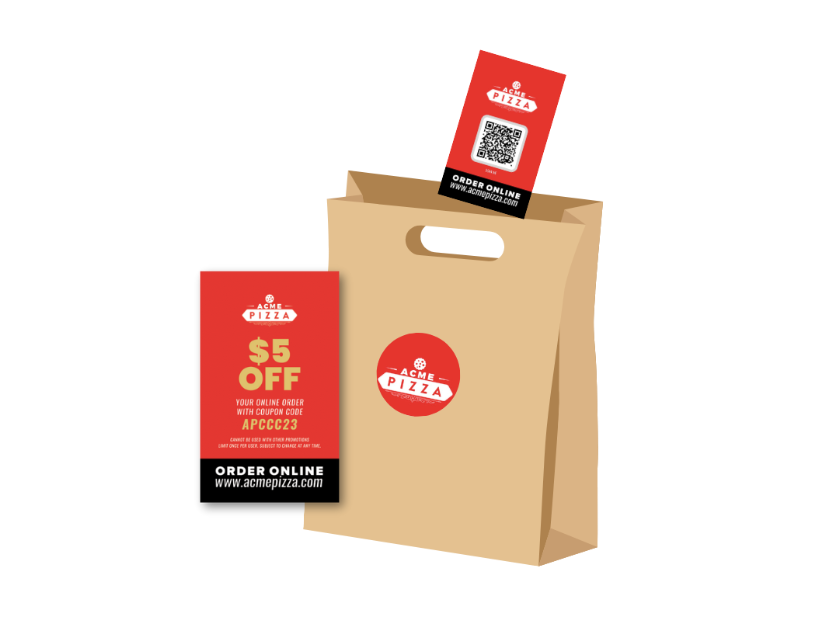
Menufy’s Conversion Cards
If you convert just 30% of your repeat marketplace guests to direct ordering, you are saving 30% of what you were paying in commissions on those orders, every month, compounding. For a $15K per month delivery restaurant, that is over $1,000 per month recaptured in year one.
What to look for in a direct ordering system
Whether you are evaluating online ordering for small restaurants or a multi-location operation, not all direct ordering platforms are created equal. The right restaurant online ordering system will give you a clear answer to each of these five questions:
Does the platform charge you a commission, or does it pass a small convenience fee to the guest? (The distinction matters: on a direct ordering platform, the restaurant pays nothing per order — the guest pays a small convenience fee, and the restaurant keeps 100% of the transaction.)
Do you fully own your guest data, including email and order history?
Is your Google listing actively protected?
Does the platform integrate with your existing POS?
What does support look like when something goes wrong during peak hours?
These questions separate platforms that genuinely work in your interest from ones that are just a slightly cheaper version of the same problem.
Menufy gives independent restaurants a direct ordering channel built to convert marketplace guests into repeat direct customers, with a custom website, automated marketing, Google listing protection, and a 24/7 Success Team.