
Based on Menufy's 2026 consumer survey
You didn't open a restaurant to become a marketing expert. But here's the uncomfortable truth: a guest who has never tasted your food has probably already decided whether to order from you, based entirely on what they found (or couldn't find) on your own website, Google listing, or social presence — not on a marketplace or delivery app.
Menufy surveyed 1,000 U.S. consumers about how they discover, evaluate, and choose restaurants. The results aren't surprising, exactly. What might surprise you: when trying a new restaurant, most guests prefer to order directly from that restaurant — not through a marketplace. They only turn to a marketplace when they can’t easily find what they’re looking for on your own channels. The data puts numbers on exactly where you’re losing guests, and more importantly, what to do about it.
The Bottom Line
None of this is revolutionary. You probably already knew that your Google presence mattered, that reviews helped, that your menu should be easy to find. The value of the data is in the specifics: how much each of these things matters, and how many guests are quietly walking away because of gaps that are genuinely fixable.
The restaurants winning on these fronts aren't the ones with the biggest budgets. They're the ones who've made the basics consistent: an accurate listing, a current menu, a working order button, and a steady drip of real reviews. The ones keeping their content fresh, updating the menu whenever something changes, and reaching guests regularly with hyper-personalized messages that give them a reason to come back. That habit — not a one-time fix — is what drives repeat business and long-term loyalty. The tools now exist to make it automatic, like Menufy, without adding to an already full plate.
““Most guests want to order directly from you — not from a marketplace. But they’ll only do that if they can find you, trust what they see, and complete an order without friction. When that experience breaks down, they don’t complain. They just go somewhere else. What this data shows is that the gap isn’t about budget or brand. It’s about consistency: keeping your menu current, your listing accurate, and your guests feeling like you know them. The restaurants that get this right aren’t just capturing more orders. They’re building the kind of loyalty that marketplaces can’t touch.” ”
How do most diners discover new local restaurants?
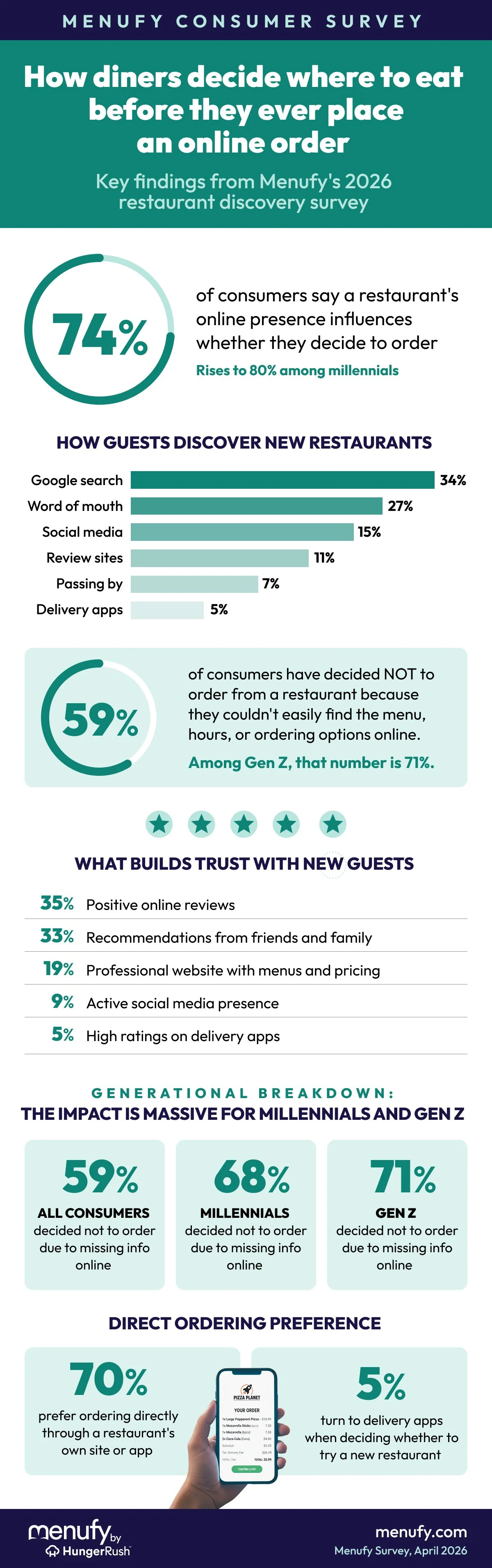
According to Menufy's 2026 consumer survey of 1,000 U.S. adults, 34% discover new local restaurants through a Google search, making it the most common discovery channel. Word of mouth comes second at 27%, followed by social media at 15% and review sites at 11%. Only 5% say they use third-party delivery apps when deciding whether to try a new restaurant, meaning search, social, and referrals drive the vast majority of discovery for independent restaurants.
Why does a restaurant's online presence matter for getting more orders?
Menufy's survey found that 74% of consumers say a restaurant's online presence — its website, photos, reviews, and menu availability — directly influences whether they decide to order. More critically, 59% say they have decided not to order from a restaurant simply because they couldn't find basic information like the menu, hours, or ordering options online. A strong online presence doesn't just help with discovery; it removes the friction that causes potential guests to leave before they ever place an order.
What information do guests look for before ordering from a restaurant?
Guests primarily want to confirm three things before ordering: what you serve, when you're open, and how to place an order. When any of those are hard to find or out of date, nearly 6 in 10 consumers say they've moved on to another restaurant as a result. The fix is ensuring your menu is current and easy to find, your hours are accurate across Google, Yelp, and your website, and there's a clear direct ordering option that works on mobile.
Do online reviews help a restaurant get more orders?
Yes, significantly. Positive online reviews are the single biggest trust factor for new guests, cited by 35% of consumers in Menufy's survey — more than personal recommendations, a professional website, or social media presence. Reviews also influence local search rankings and AI-generated search results, meaning more recent positive reviews make your restaurant more likely to show up when someone searches "best [cuisine] near me." For independent restaurants, consistently generating and responding to reviews is one of the highest-ROI marketing activities available.
Do guests prefer ordering directly from a restaurant or through a delivery app?
A clear majority — 70% of consumers surveyed — say they prefer to order directly through a restaurant's own website or app when given the option. Delivery apps play a useful role in order volume and reach, but they're not where most guests go when deciding whether to try a new restaurant, and they're not where most guests prefer to order when given a choice. Restaurants that offer a fast, mobile-friendly direct ordering experience can capture more of this preference while keeping more of the revenue from each order.
How does local SEO help an independent restaurant get found online?
Local SEO determines whether your restaurant shows up when someone searches "tacos near me" or "pizza delivery open now." The same signals that drive local search rankings — an accurate Google Business Profile, positive reviews, and a mobile-friendly website with your current menu — also determine whether your restaurant is cited in AI-generated answers from Google, ChatGPT, and Perplexity. Menufy connects a direct ordering link to your Google Business Profile so guests can go from search to checkout without friction, and manages reviews through AI-powered reply suggestions and automated feedback capture after every order.
What are the most important things an independent restaurant can do to get more orders online?
Based on Menufy's consumer survey data, the five highest-impact actions are: keep your Google Business Profile accurate and complete; make your menu easy to find on mobile with a clear path to order; generate and respond to reviews consistently; ensure your information is consistent across Google, Yelp, and your website; and offer a direct ordering option on your own site. None of these require a marketing team or a large budget. They require consistency.
Based on a consumer survey commissioned by Menufy and conducted by Dynata in April 2026 among 1,000 U.S. consumers aged 18 and older.