
A restaurant loyalty program is one of the highest-ROI tools an independent operator can run. Yet most owners never set one up, or set one up wrong.
"My regulars already come back. I don't need a loyalty program." Most independent restaurant owners have had this conversation with themselves.
It's reasonable, but it's also costing more than you'd think.
The problem with relying on regulars without a formal program: you have no visibility into when they stop coming. No early warning, no mechanism to bring them back, no data on who your best guests are or what they order. A loyalty program isn't about making loyal guests more loyal. It's about knowing when loyalty is slipping before it's gone, and having a system that does something about it.
For most of restaurant history, that kind of system was only available to large chains. Starbucks Rewards members now account for roughly 60% of all U.S. company-operated revenue. Domino's doubled loyalty redemptions for pickup orders after relaunching its program, proof that the right incentives shift guests toward more profitable ordering channels. Independent operators couldn't replicate that because the technology cost tens of thousands of dollars to build. Cloud-based platforms changed that. Menufy's Tasty Rewards program is bundled into the Menufy marketing package for restaurant partners.
Why a restaurant loyalty program delivers the best ROI
The economics of guest retention are dramatically better than new guest acquisition. Research published in the Harvard Business Review found that acquiring a new guest costs five or more times what it costs to retain an existing one. Loyalty program members consistently generate more revenue per visit and return more frequently than non-members.
The guest who orders directly from your restaurant and has a loyalty incentive to come back is your highest-value customer. Research consistently shows that digital ordering guests visit more frequently and spend more per order than walk-in-only guests. Loyalty program members on top of that return at even higher rates. Building a program that connects both behaviors is where the real ROI lives.
The gap between punch card sign-up rates and digital enrollment is significant, and it's almost entirely explained by friction. Digital enrollment happens at the moment of purchase, so guests opt in without a second thought. The easier you make it, the more guests join without thinking about it. No separate app, no paper card, no follow-up ask after the sale.
"Earn 1 point per dollar, get a free appetizer at 100 points" is clear. "Earn stars toward reward tiers" is not. The simpler and more tangible the reward, the better the engagement. For casual dining, a free item after a set number of visits outperforms percentage discounts because it feels like a real gift, not a math problem guests have to solve.
The highest-performing loyalty programs reach guests when they're most likely to order: a nudge when they're close to a reward, a re-engagement message when they haven't ordered in a while. Reaching a guest before they default to a third-party app is what drives repeat direct orders. Set these up once and they run without you.
A loyalty program that runs through a third-party app is still paying 20–30% commission on every redemption. The reward goes to the guest; the margin goes to the platform. When loyalty is connected to your direct channel, you keep the revenue and the relationship. You don't have to manage mailing lists, track order behavior, or initiate campaigns yourself.
How Menufy's Tasty Rewards loyalty program works
Here's something guests appreciate and most restaurant owners don't expect: Menufy's Tasty Rewards doesn't require a minimum order size to redeem. Guests earn credits by ordering a set number of times. Once they hit that visit threshold, they can apply their earned credits to any future order, regardless of what's in the cart.
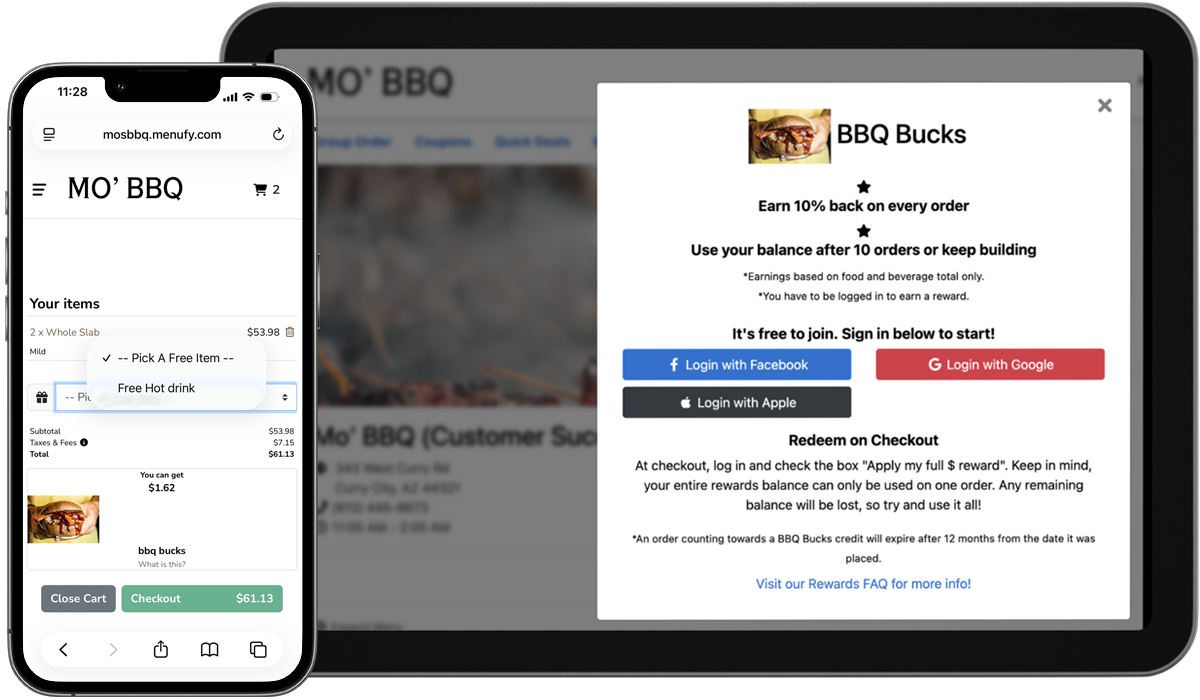
That lack of a redemption minimum matters more than it sounds. Guests who know they can use their reward on a small order are more likely to actually redeem, which means more return visits. And because the reward was earned through repeat visits rather than a one-time discount, you're not giving away margin on orders that would have happened anyway.
A loyalty program no one knows about does nothing. Every delivery bag, every receipt, every follow-up text should mention the program for the first 90 days. Guests who don't know it exists can't opt in, and a slow start makes it much harder to build the member base needed to see results.
If a guest has to order 15 times to get a free side dish, the program isn't creating meaningful motivation. Guests need to feel progress quickly or they stop engaging. Test shorter redemption cycles early and watch whether order frequency increases before locking in your structure.
This is only a concern if your rewards replace purchases that would have happened anyway. On a $30 order with a $3 reward cost, you're giving up 10% on that transaction to drive a return visit that would otherwise cost you significantly more in paid acquisition or third-party commission. Visit-based rewards are structured to increase order frequency, not discount orders guests were already going to place.
It happens, but rarely at a meaningful scale for independent restaurants. Most loyalty abuse occurs on programs with high-value sign-up bonuses or poorly designed referral incentives. A straightforward points-per-dollar structure with reasonable redemption minimums is low-risk and easy to monitor.
How much time does managing a restaurant loyalty program actually take?
When software companies say something "runs in the background," that's often code for "you'll still need to manage it." Realistically, initial setup takes 30 to 60 minutes to configure your reward structure and write your first promotional message. After that, the automated triggers handle follow-ups, point reminders, and reward notifications without you touching them. The main ongoing task is checking in on redemption rates every month or so and adjusting reward thresholds if something isn't performing. For most independent restaurant owners, that's less than an hour a month.
Are restaurant loyalty programs worth it for small restaurants?
Yes, and the economics are better than most owners expect. Retaining an existing guest costs a fraction of acquiring a new one, and loyalty program members consistently order more frequently and spend more per visit than non-members. Cloud-based platforms have made the same infrastructure available to independent restaurants that only large chains could afford a decade ago.
How do restaurant loyalty programs work?
Guests earn points or credits by ordering a set number of times or spending a certain amount. Once they hit a threshold, they can redeem those credits for a free item or discount on a future order. The best programs connect enrollment, tracking, and automated follow-up in one system so neither the restaurant nor the guest has to manage anything manually.
What is the best loyalty program for independent restaurants?
The best program for an independent restaurant is one that enrolls guests at checkout without friction, offers a tangible reward tied to visit frequency, and sends automated reminders without requiring manual campaigns. Menufy's Tasty Rewards is bundled into the Menufy marketing package and handles all of this through your direct ordering channel with no third-party commissions on redemptions.
How much does a restaurant loyalty program cost?
It depends on the platform. Legacy systems cost tens of thousands of dollars to build and maintain. Menufy's Tasty Rewards is included in the Menufy marketing package, so there's no separate line item. It runs as part of your existing direct ordering and marketing setup.
What's the difference between a points-based and visit-based loyalty program?
Points-based programs reward spending (e.g., $1 = 1 point). Visit-based programs reward showing up (e.g., a free item after 8 orders). For casual dining and delivery-focused restaurants, visit-based programs tend to drive higher order frequency because the reward is tied to returning, not to how much the guest spends each time.
Want to talk to someone about how a rewards program can work for your restaurant? Let's chat about Tasty Rewards in action. Points, rewards, and automated follow-ups all included and bundled into your Menufy marketing package.
ABOUT THE AUTHOR
Courtney Kitchens, SR. MARKETING SPECIALIST
Courtney, an English teacher turned marketer at Menufy, draws inspiration from the restaurant industry's everyday moments. Her writing is a testament to her expertise, providing insightful and compelling accounts of the industry's diverse and vibrant nature.