
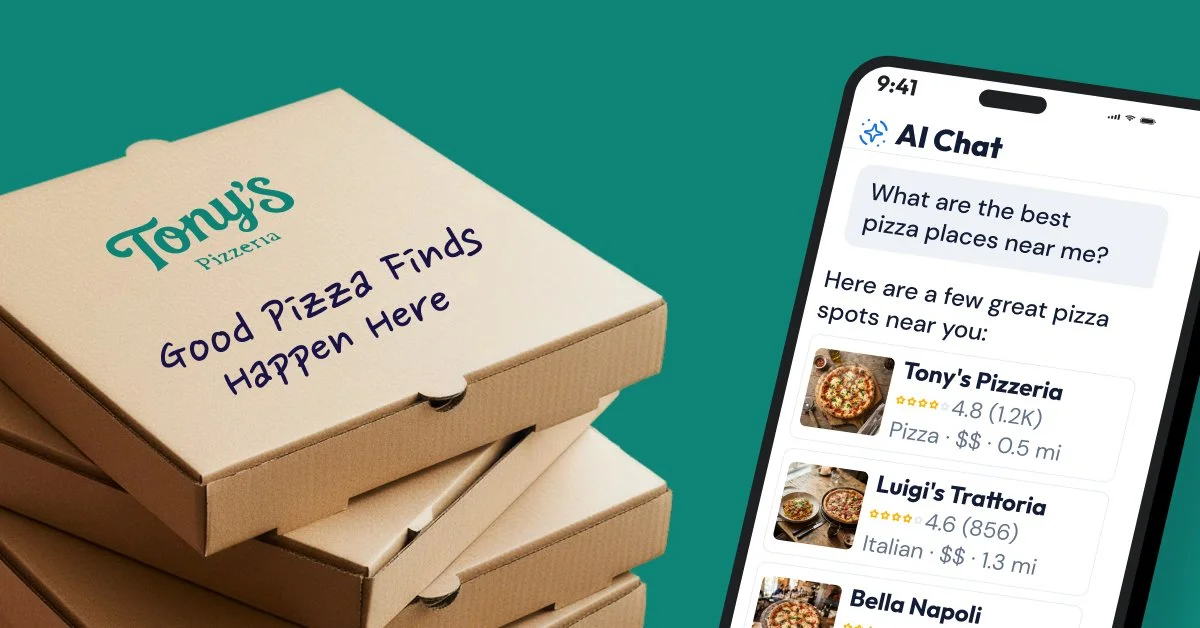
AI can feel like a mystery right now. New tools, new terms, new headlines every few weeks. But once you look past the noise, what's actually happening with AI and restaurant discovery is pretty straightforward.
Guests are starting to ask ChatGPT, Gemini, or Google's AI Overviews where to eat, alongside searching Google the way they always have. The shift is real, but it's more gradual than it sounds, and it runs on the same handful of fundamentals independent restaurants have always controlled: a complete online presence, real reviews, and accurate information guests can trust.
Let's walk through what's actually happening, what you can do about it starting today, and where it makes sense to bring in help.
How AI is actually changing restaurant discovery
A few real shifts are underway, worth understanding.
Guests are more willing to act on AI recommendations than they used to be. In a recent EMARKETER and Fractl survey of U.S. consumers, 70% said they're using AI tools more than they were a year ago, and 18%, nearly 1 in 5, said they've already made a purchase based on an AI recommendation without double-checking it through search first. That behavior is about 2.5 times more common among Gen Z and millennials than among baby boomers.
AI tends to answer with a short list, not a scroll. Instead of a page of links, conversational AI tools and AI Overviews often name only one or two restaurants instead of the usual three you'd see in Google's local pack. Fewer restaurants get mentioned in any single answer, but the ones that do get more of the guest's attention.
AI looks for confidence, not popularity. When your hours, menu, and location can be confirmed in more than one place and none of it contradicts itself, AI tools describe you with certainty. When it can't confirm the basics, it tends to leave you out entirely rather than guess. This is less about being well known and more about being clearly documented.
Search itself is starting to take action, not just point you somewhere. Google has begun testing AI features that can check availability and handle restaurant reservations directly inside search, rather than only linking out to a booking site.
Most of these questions are still research, not a snap decision. Guests use AI to narrow down a shortlist the same way they've always used Google, review sites, and recommendations from friends. It's a new tool for an old habit.
None of this replaces Google search or your Google Business Profile. It layers on top. The restaurants that show up in AI answers are pulled from the same signals that have always mattered: how complete your online presence is, what your reviews say, and whether your information is accurate and consistent.
Guests are warming up to AI
70%
of consumers say they use AI tools more than a year ago
18%
have purchased based on an AI recommendation without checking search first
2.5x
more common among Gen Z and millennials than baby boomers
Source: EMARKETER and Fractl consumer survey
Why AI search isn't as mysterious as it seems
Here's the part that often gets missed: AI recommendations run on the exact fundamentals independent restaurants are well positioned to nail.
Large chains typically have entire teams dedicated to search, content, and online marketing. Keeping every profile current and every algorithm shift accounted for is someone's full time job. Most independent restaurants don't have that kind of dedicated team, and that's the honest challenge here. You're running a kitchen, managing staff, and keeping guests happy, and staying on top of AI and search fundamentals on top of all that is a lot to ask of any one person.
AI tools also lean heavily on authenticity and specificity, not marketing budget. A restaurant with detailed, honest reviews and a clearly described menu gives AI something concrete to recommend. A restaurant with a vague profile and stock photos gives it nothing to work with, no matter how big the brand is.
Menufy's own research backs this up in a smaller way too. In our April 2026 survey, 74% of guests said a restaurant's online presence directly influences whether they order, and 59% said they'd abandoned an order at some point because they couldn't find the information they needed. That pattern holds regardless of whether the guest found you through Google or asked an AI assistant.
If you want the fuller breakdown of what's shifted in local search itself, we covered it in Local SEO for Restaurants in 2026 piece.
What independent restaurants can do about AI search today
None of this is a one time fix. It's ongoing work, the same way keeping a clean kitchen or a current menu is ongoing work. But it's worth doing consistently, because it's exactly what keeps guests finding you and choosing you over the restaurant next door.
Get the essentials of your Google Business Profile locked down
Confirm your hours (including holiday hours), make sure your primary category actually matches your cuisine, and add your direct ordering link somewhere visible. This one profile feeds Google, Maps, and most AI tools at once.
Make your menu do the talking
"Pasta dish" tells AI and guests nothing. "Hand rolled pappardelle with wild mushroom cream sauce" gives them something to picture, and something to match to a search like "best mushroom pasta near me." Specific dish names, ingredients, and a couple of honest descriptive words go a long way.
Turn reviews into an asset instead of an afterthought
Ask guests what they ordered, not just how their visit was. Detailed reviews that mention specific dishes carry more weight with AI tools and with the next guest reading them. Respond to reviews, good and bad. It signals that someone's actually running the place.
Keep your information consistent everywhere
Your name, address, phone number, and hours should match exactly across your website, your Google Business Profile, and any delivery apps you're listed on. Mismatched information is one of the most common reasons AI tools (and guests) lose confidence in a listing.
Make direct ordering the obvious next step
If a guest lands on your Google profile or your website and the easiest button to tap sends them to a third party app, you're paying a commission on a guest who was already looking for you by name. Put your own ordering link front and center.
Don't chase every new AI tool that shows up in your inbox. The restaurants that will do well here aren't the ones with the flashiest tech stack. They're the ones with accurate, consistent, specific information. That's the whole game, and it's one you can play without adding a single new subscription.
Your online presence checklist
Most of what AI and Google both look for fits on one short list.
Hours and holiday hours are accurate
Primary category matches your cuisine
Direct ordering link is easy to find
Menu describes actual dishes, not generic categories
Name, address, and phone number match everywhere you're listed
Reviews are being answered, not ignored
Six items. No new subscriptions required.
What Menufy handles: This is exactly what Menufy's Success Team handles for the 25,000+ independent restaurants we work with: a website built with the clear, structured information search engines and AI tools look for, a managed Google Business Profile, and marketing, email, text, and loyalty campaigns built to turn that visibility into direct orders, not just clicks. If reading that checklist made your stomach sink a little, that's normal. Staying visible and staying accurate is ongoing work, and it's easy to let slide while you're also running a kitchen. If you'd rather not manage all of that alone, that's exactly what a partner like Menufy is for. It's a conversation we have with independent restaurant owners every day.
The takeaway
AI didn't hand independent restaurants a new problem to solve. It raised the stakes on the same fundamentals that have always driven restaurant discovery: a complete profile, honest reviews, and information guests (and now AI) can trust. Get those right and you're already positioned for whatever comes next.
Want to see how your online presence stacks up? Talk to your Success Team and we'll walk through it with you.

FAQ
Is AI search going to replace Google for restaurant discovery?
Not any time soon. Google search still handles the large majority of restaurant searches. AI tools are a smaller, growing slice layered on top, not a replacement for it.
Do I need a completely different strategy for AI search versus Google?
No. AI recommendations draw on the same signals as Google: your online presence, reviews, menu accuracy, and consistent information. Keeping those strong helps you show up well in both places.
Why do some restaurants seem to disappear from AI recommendations entirely?
Usually because the basics can't be confirmed. Inconsistent hours, an unclaimed profile, or contradictory information across listings gives AI tools a reason to leave you out rather than guess wrong.
Does my online presence really affect whether guests order?
Yes. Menufy's own research found that 74% of guests say a restaurant's online presence influences whether they order, and 59% have abandoned an order because they couldn't find the information they needed.
Do independent restaurants have a disadvantage against big chains with AI?
Not necessarily. Independent restaurants can update their information faster and tend to have more distinctive, authentic descriptions and reviews, both of which AI tools and human guests respond well to.
What's the single most useful thing I can do this week?
Open your Google Business Profile and check that your hours, menu, photos, and ordering link are accurate and match your website. It's the foundation everything else builds on, and it's the fastest fix on this list.