
The question isn't whether to serve off-premises guests, it's how you do it. Per the National Restaurant Association's 2025 research, nearly 75% of all restaurant traffic now happens off-premises, whether that's takeout, delivery, or drive-thru, and the direction of travel is clear. The real question is which combination of platforms gives your restaurant the best margin, the most guest data, and the strongest long-term growth trajectory.
What third-party apps actually do well
Third-party delivery platforms are discovery engines. A new guest who's never heard of your restaurant might find you on DoorDash, order once, and become a regular, and that reach is worth protecting, not walking away from.
We broke down exactly what that discovery costs, and what Menufy's negotiated 12.5% rate changes, in our guide to restaurant delivery app fees. This post picks up from there: once you understand the cost, how do you actually decide where your orders should go?
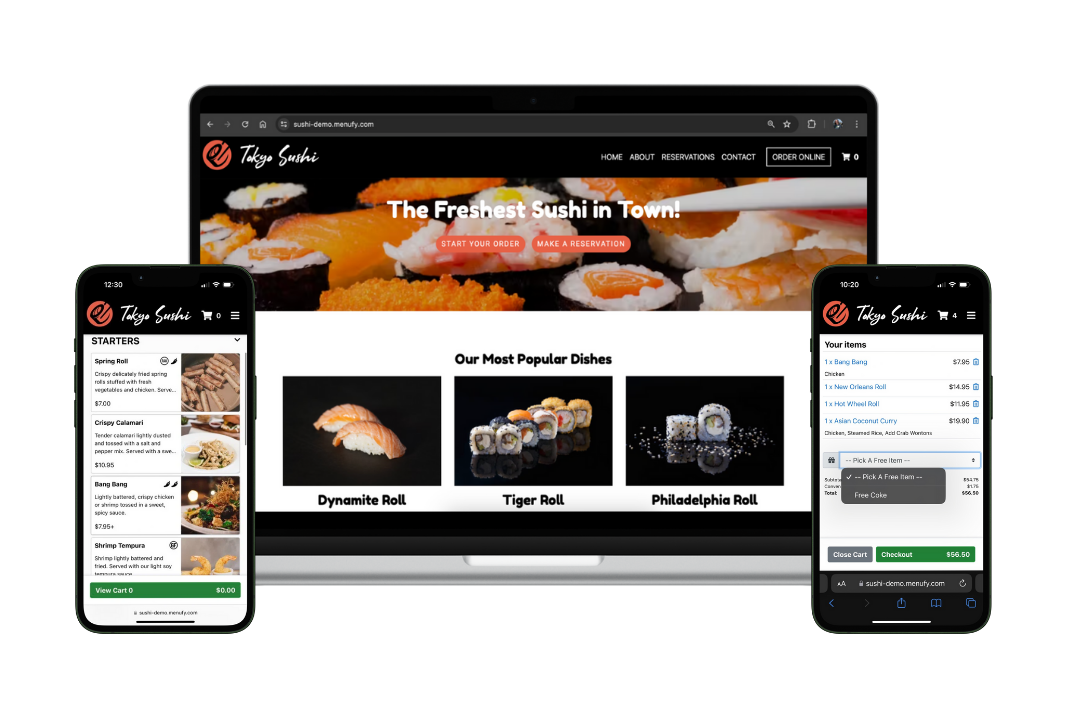
Direct ordering flips that, and Menufy makes it simple to switch. We build you a custom ordering website with your own branding and menu, no design work or IT headaches involved. Every guest who orders through it hands you their email or phone number at checkout, so every order builds a guest list that's actually yours. From there, Menufy's email and text marketing tools put that list to work automatically, bringing guests back without you lifting a finger.
How to decide your channel mix
There's no universal split that works for every restaurant. The right mix depends on where you are right now.
If you're newer or in a competitive market, lean on third-party apps for now. You need the discovery more than you need to protect margin on every order. Direct ordering matters more once you've built enough volume to have guests worth retaining.
If you already have a loyal local following, shift weight toward direct ordering. Guests who already know your name don't need a marketplace to find you again, and every order that still runs through a third party at that point is a discovery fee on someone who wasn't actually discovering you.
If you're expanding into a new neighborhood or launching a new concept, treat third-party apps as your awareness budget until local search and word of mouth catch up.
If most of your volume is already repeat guests, that's a signal your channel mix is overdue for a shift, not a reason to keep paying full commission on people who would happily order direct.
Here's a quick gut check: if most of this month's orders came from guests you've never seen before, third-party is doing its job and doesn't need to change. If most of this month's orders came from guests who've ordered from you at least twice, some of that volume belongs on your own site instead.
What changes beyond the commission
Cost is only part of the decision. The two channels also feel different to run, and different for guests.
On a marketplace, your menu sits next to every competitor within delivery radius, sorted by whatever the platform's algorithm favors that day. Your photos, your placement, even your restaurant's visibility can shift based on decisions the platform makes, not you. On your own site, the guest sees only your restaurant, your photos, your specials, your story, with nothing pulling their attention toward a competitor three taps away.
Promotions work differently too. Running a deal on a marketplace often means opting into a promotion structure the platform designed. On a direct site, a discount, a loyalty perk, or a limited-time offer is entirely yours to set and change whenever you want.
None of this replaces the commission math. It's the part of the decision that doesn't show up on an invoice.
Menufy is built for the hybrid model, not just one side of it: a custom website and direct ordering guests actually want to use, plus a lower commission rate on DoorDash and Uber Eats while you build that direct channel.

FAQ
Should I stop using DoorDash and Uber Eats?
No. They're still one of the best ways for new guests to find you. The decision isn't third-party apps or direct ordering, it's how much weight each one should carry as your restaurant grows.
How do I decide how much of my business should run through each channel?
Look at where your guests are coming from. If most of your volume is new guests you've never seen before, lean on third-party discovery. If most of your repeat guests are still ordering through a marketplace, that's commission you're paying on guests who'd order directly if you gave them an easy way to.
Does the guest experience actually differ between a marketplace listing and my own site?
Yes. On a marketplace, guests see your menu next to every competitor nearby and the platform controls placement and promotions. On your own site, guests see only your restaurant, and you control the menu, the offers, and the ordering experience end to end.
What's the biggest risk of relying only on third-party apps?
You never build a guest list of your own. Every guest stays the platform's guest, not yours, which means your growth is capped by how much you're willing to keep paying in commission.