

Before someone books a table or places an order, they search first. “Best tacos near me.” “Italian restaurant open now.” “Where can I get gluten-free pizza delivered.” And increasingly, they're not even typing that into Google. They're asking ChatGPT or an AI Overview to just tell them where to go.
If your restaurant doesn't show up in that moment, it doesn't matter how good the food is.
This checklist breaks down what it actually takes for an independent restaurant to get found, on Google, on maps, and now in AI-driven search too. Some of it you can do yourself. Some of it is exactly what Menufy's Success Team handles for restaurant partners every day. We've flagged both, so you know where to spend your own time and where you can hand it off.
Want the short version? Download the one-page restaurant SEO checklist (PDF) and keep it by the register or pin it to your office wall.
How to use this checklist
We've grouped these into five sections:
Foundation checklist
Local search and keyword checklist
Website and technical checklist
Content and menu checklist
Reviews, links, and AI search checklist
You don't need to tackle all of it at once. Independent restaurant owners are already running a kitchen, a staff, and a dining room. Start with the section that matches your biggest gap, then come back for the rest.
The accounts and tools that give you visibility
These give you a window into how guests are actually finding you, and lay the foundation for everything else on this checklist.
This is the single most important listing for any restaurant. It's what shows up when someone searches your name or “restaurants near me,” and it's what powers your pin on Google Maps. Make sure your hours, address, phone number, menu, and photos are accurate and complete. An out-of-date profile sends guests to a competitor without you ever knowing it happened.
Menufy sets up and optimizes your Google Business Profile as part of onboarding, so this one is already checked off for Menufy partners.
This free tool shows you what people are searching to find your website, and flags any technical issues search engines run into on your site.
Track which pages guests visit, how they found you, and whether they actually order once they land on your site. This tells you if your marketing is working, not just whether people are looking.
If your website ever picked up spammy backlinks or duplicate content from an old builder, Google can flag it. A quick check in Search Console rules this out.
If Google can't find and read your pages, none of the rest of this matters. This also affects whether AI tools like ChatGPT and AI Overviews can find you, since many of them pull from Google's index.
Match what you offer to what guests are typing
Guests don't search the way you'd expect. They search by craving, occasion, and neighborhood, not your menu terminology.
You know your menu by dish name. Guests search by craving: “spicy ramen delivery,” “birthday dinner spot,” “patio seating near me.” Build your website and Google Business Profile copy around how people actually search, not just your menu terminology.
Search your own cuisine and neighborhood and see who shows up. Note what their listings and websites emphasize, then find the gap. Maybe nobody nearby mentions late-night hours, family portions, or catering.
Group your searches into themes: signature dishes, cuisine type, occasion (date night, family dinner, group catering), and neighborhood. Each theme should map to a page or section on your site, whether that's your menu page, an about page, or a catering page.
Try searching your own cuisine or neighborhood in ChatGPT or a Google AI Overview. See what gets recommended and how. If competitors show up and you don't, that's a gap in how your content is structured, which the content and menu checklist below addresses.
Search “best [your cuisine] in [your city]” and see what kind of content shows up: review roundups, other restaurant sites, local blogs. That tells you what guests expect to see before they choose where to eat.
Do you deliver? Is there parking for pickup? Are you kid-friendly? Do you offer gluten-free or vegan options? These are the questions guests search before they commit. Answer them clearly on your website and your Google Business Profile.
Seconds decide whether a guest orders
If your site is slow, hard to read on a phone, or confusing to navigate, guests go back to search results and pick someone else.
A secure site is a baseline trust signal for both guests and search engines. Look for the padlock icon next to your web address to confirm.
Your site shouldn't be reachable through four different web addresses (www, non-www, http, https) without redirecting to one primary version. This confuses search engines and can split your visibility.
A slow-loading menu or ordering page costs you orders. Guests on their phone, standing outside your restaurant or scrolling on their couch, won't wait around.
Menufy builds every partner a mobile-optimized, custom-branded ordering site designed for speed, so this one is handled for you from day one.
Old menu PDFs, expired promo pages, or a broken “Order Now” button send guests nowhere. Check your site regularly, especially after menu updates.
Most guests are searching and ordering from their phone. Google has also moved to indexing mobile versions of sites first, so a site that isn't mobile-friendly can lose visibility entirely.
Every Menufy site is built mobile-first, so guests get the same easy ordering experience whether they're on a phone, tablet, or laptop. See how this compares to a marketplace listing in our guide to the best online ordering system for restaurants.
Structured data helps search engines understand your hours, menu items, prices, and reviews well enough to show them directly in search results, sometimes before a guest even clicks through.
Guests should be able to find your menu, hours, location, and ordering button within one or two clicks from your homepage. If it takes longer, they'll leave.
Write for guests and for AI tools at once
Your website content should do double duty: help guests decide to order, and help search engines and AI tools understand exactly what you offer.
“Menu” as a page title tells search engines nothing. “Authentic Italian Menu, Downtown Springfield” tells them exactly what you serve and where.
Alt text describes your images to search engines and to guests using screen readers. “Margherita pizza with fresh basil and mozzarella” helps you show up in image search and makes your site more accessible.
Outdated hours or a menu that still lists a dish you discontinued last year erodes guest trust fast, and search engines and AI tools favor content that's kept up to date.
A short blog post about your catering options, your story, or a seasonal menu launch gives search engines and AI tools more to work with, and gives guests a reason to trust you before they ever walk in.
AI tools tend to pull the sections that answer a question fully and clearly. Instead of a vague “great food, great atmosphere,” write specifics: “We're a family-owned Thai restaurant with a full vegan menu and free parking on Elm Street.”
Trust signals that carry the most weight
Reviews and mentions are some of the strongest trust signals a restaurant has, for guests and for search engines and AI tools alike.
A quick nudge after a great meal, whether that's a table tent, a receipt line, or a follow-up text, goes a long way. More recent, relevant reviews help you rank higher in local search and give AI tools more to reference when recommending restaurants nearby. See our full guide on how to get more Google reviews for the ask-and-response scripts that work.
Menufy partners send an automated feedback survey 90 minutes after every order and use AI-powered review replies that sound like the restaurant, not a template. Across the Menufy network, that's generated 3,000-plus Google reviews for partner restaurants.
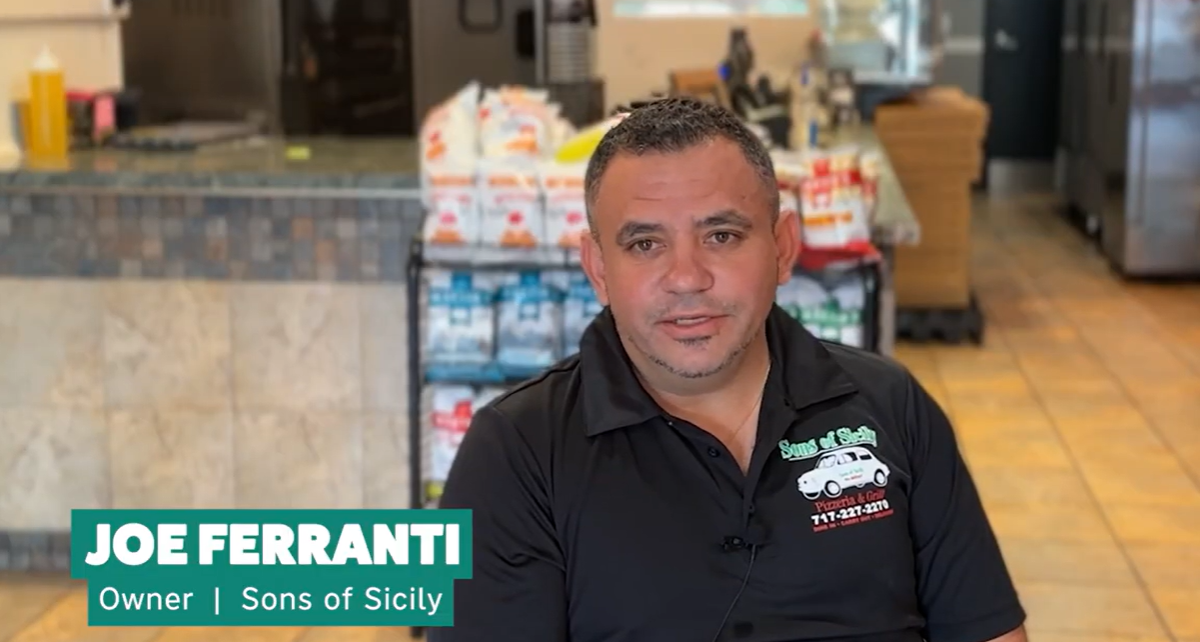
“With Menufy, since day one it's been easy. It's seamless, fast, and convenient.”
Joe Ferranti, Owner · Sons of Sicily
A thoughtful response shows guests, and search engines, that someone's actually paying attention. It also gives you a natural place to mention neighborhood, cuisine, and specialties in your own words.
A mention from a local food blogger, news site, or “best of” roundup, even without a link back to your site, reinforces to search engines and AI tools that your restaurant is a real, relevant local business. Reach out when you launch something new: a seasonal menu, a renovation, a milestone anniversary.
Execute this checklist
You don't have to do all 25 of these yourself. That's the whole idea behind Menufy: a custom-branded ordering site, Google Business Profile setup, review generation, and marketing that runs in the background, backed by a Success Team that's already on it.
Grab the one-page checklist PDF to track your progress to see what's already covered for you, and where you can pick up quick wins on your own.
25,000-plus independent restaurants are already growing with Menufy.

FAQ
How long does restaurant SEO take to show results?
Most independent restaurants see early movement, like better Google Business Profile visibility and more calls or direct orders, within a few weeks of cleaning up the basics. Ranking higher for competitive local searches usually takes a few months of consistent reviews, updated content, and an optimized listing.
Do I need a separate website if I'm already on delivery apps?
Yes. Delivery apps control the guest relationship and take a cut of every order. Your own website, built for direct orders, is what search engines and AI tools point guests to when they search for you by name, and it's what lets you actually own that guest relationship going forward.
What's the fastest way to improve my restaurant's local SEO?
Start with your Google Business Profile. Make sure hours, menu, photos, and categories are complete and accurate, then focus on getting a steady stream of recent reviews. Those two things move the needle faster than almost anything else.
Do AI tools like ChatGPT actually recommend restaurants?
Increasingly, yes. When someone asks an AI tool for a restaurant recommendation, it pulls from the same signals that drive traditional search: your Google Business Profile, your website content, and your reviews. Keeping those accurate and current helps you show up there too.
Can Menufy handle all of this for my restaurant?
Menufy builds and hosts your ordering site, sets up and optimizes your Google Business Profile, and runs the marketing and review generation that keeps your listing active and current. Your dedicated Success Manager handles the ongoing work so you can stay focused on the restaurant.